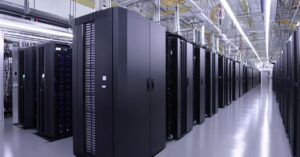

The rapid expansion of artificial intelligence, machine learning, and GPU-intensive workloads has fundamentally changed the demands placed on data centre infrastructure. Modern AI servers and GPU clusters generate significantly more heat per rack than traditional IT equipment. Conventional cooling approaches were never designed to handle this shift. As average rack density reaches 27 kW and continues to rise , managing heat has become a critical operational priority. Cold aisle containment (CAC) has emerged as one of the most effective solutions available to data centre managers seeking to maintain performance, protect hardware, and control energy costs.
What Is Cold Aisle Containment?
Cold aisle containment is a data centre cooling strategy that physically separates cold supply air from hot exhaust air. In a standard server row layout, IT equipment draws in cool air from the front (the cold aisle) and expels equipment exhaust air from the rear (the hot aisle). Without containment, cold and hot air mix freely, reducing cooling efficiency and creating temperature inconsistencies across the facility. A cold aisle containment system addresses this by enclosing the cold aisle with panels, doors, and ceiling sections, directing cold supply air precisely to equipment intakes. Compared with hot aisle containment, CAC is generally easier to retrofit into existing facilities and offers strong compatibility with both raised floors and overhead air distribution.
Why AI Data Centres Need Advanced Cooling
AI workloads place demands on infrastructure that traditional data centre designs did not anticipate. High-performance GPUs generate substantially more heat per unit than CPUs. A single GPU server rack can exceed 60 kW to 100 kW, compared with 5 kW to 10 kW for standard compute racks. AI training runs are sustained and continuous, meaning there is little opportunity for passive cooling cycles. Inference workloads add further load as deployments scale. Without adequate thermal management, hotspots develop across cold aisles, GPU performance degrades, and the risk of hardware failure increases. Cold aisle containment solutions provide the precise, consistent cooling that AI environments require.
How a Cold Aisle Containment System Improves Cooling Efficiency
The core benefit of a cold aisle containment system is the prevention of hot and cold air mixing. By enclosing the cold aisle, supply air is delivered directly to IT equipment intakes rather than circulating through the wider room. This helps ensure a consistent inlet temperature across all cabinets, reduces the workload on CRAC and CRAH cooling units, and eliminates the overcooling that often results from uncontrolled airflow. Ceiling panels and end doors play a critical role in maintaining this separation. When properly sealed, with blanking panels filling unused rack spaces, CAC maximizes the efficiency of every cubic meter of cold air delivered to the data centre.
Impact on GPU Performance and AI Workloads
Maintaining consistent, controlled temperatures directly affects GPU performance. When GPUs operate above their rated thermal limits, they throttle, automatically reducing clock speeds to prevent damage. This reduces compute performance, slows AI training workloads, can increase inference response times, and reduces the return on investment from GPU infrastructure. Cold aisle containment maintains optimal supply temperatures at equipment intakes, reducing the frequency and severity of thermal throttling. The result is more reliable AI training runs, more consistent inference performance, and improved system uptime. These gains matter significantly at scale when AI workloads run continuously across large GPU clusters.
Energy Efficiency and Cost Benefits
Cold aisle containment has a measurable impact on energy efficiency. By directing cold air precisely where it is needed and eliminating recirculation, data centre managers can raise supply temperatures within ASHRAE TC 9.9 recommended ranges without compromising equipment safety. This reduces the energy consumed by cooling units, improves Power Usage Effectiveness (PUE), and lowers energy costs. For AI-intensive facilities where cooling represents a substantial portion of total energy consumption, the savings achieved through CAC contribute directly to better ROI on GPU infrastructure. Reduced carbon footprint and improved sustainability metrics are further operational benefits.
Risks of Operating Without Aisle Containment Systems
Operating an AI data centre without cold aisle containment introduces compounding risks. Airflow inefficiency and heat recirculation create unpredictable temperature conditions across aisles. Equipment exhaust air re-enters server intakes, raising inlet temperatures and accelerating thermal throttling. Energy costs increase as cooling units work harder to compensate for inefficiency. Over time, sustained high temperatures increase the likelihood of hardware failures and unplanned downtime, particularly costly when AI training jobs are interrupted mid-run. The operational and financial risks of inadequate containment grow proportionally with rack density.
Integration with Modern Cooling Strategies
Cold aisle containment is not a standalone solution. It integrates with broader cooling infrastructure and complements hot aisle containment in facilities where full perimeter containment is implemented. CAC works alongside liquid cooling and hybrid cooling systems increasingly deployed for high-density AI racks and is compatible with both raised floor plenum designs and overhead air distribution. This gives data centre managers flexibility in configuration. Aisle containment systems provide a scalable foundation that supports future AI growth without requiring a full cooling infrastructure redesign.
Best Practices for Cold Aisle Containment Implementation
Effective cold aisle containment requires precision at every stage. Proper sealing of the enclosure (including ceiling panels, end doors, and side panels) is essential to prevent air leakage. Blanking panels must fill every unused rack unit to eliminate bypass airflow. Airflow and temperature monitoring should validate containment performance and identify gaps. Regular maintenance and inspection of containment components, cooling units, and floor tiles ensures continued efficiency. A structured implementation plan, developed with a qualified data centre consultant, is strongly recommended for facilities managing high-density AI workloads.
The Role of Cleanliness in Cold Aisle Containment Performance
Dust and particulate contamination directly undermine the performance of any cold aisle containment system. Accumulation on filters, cooling coils, and server intakes restricts airflow and reduces heat transfer efficiency. In GPU environments where airflow precision is critical, even moderate contamination can disrupt the temperature consistency that CAC is designed to deliver. Routine professional cleaning, using HEPA-filtered equipment and anti-static methods, removes particulate build-up from containment components, ceiling panels, floor tiles, and the air plenum. Data Clean Asia follows industry-approved cleaning protocols designed specifically for controlled environments, supporting data centre managers in maintaining containment performance between maintenance cycles.
Protect Your AI Infrastructure with Cold Aisle Containment
Cold aisle containment is a critical enabler of reliable, efficient AI infrastructure, with a direct impact on performance, energy cost, hardware longevity, and operational resilience. Yet containment systems only deliver their full value when correctly implemented, consistently maintained, and kept free from contamination. Data Clean Asia provides specialist cleaning and maintenance support for mission-critical environments across Singapore, working within industry standards to protect the infrastructure your AI workloads depend on.
Schedule a professional cleaning assessment with Data Clean Asia today and ensure your cold aisle containment system performs at its best.